
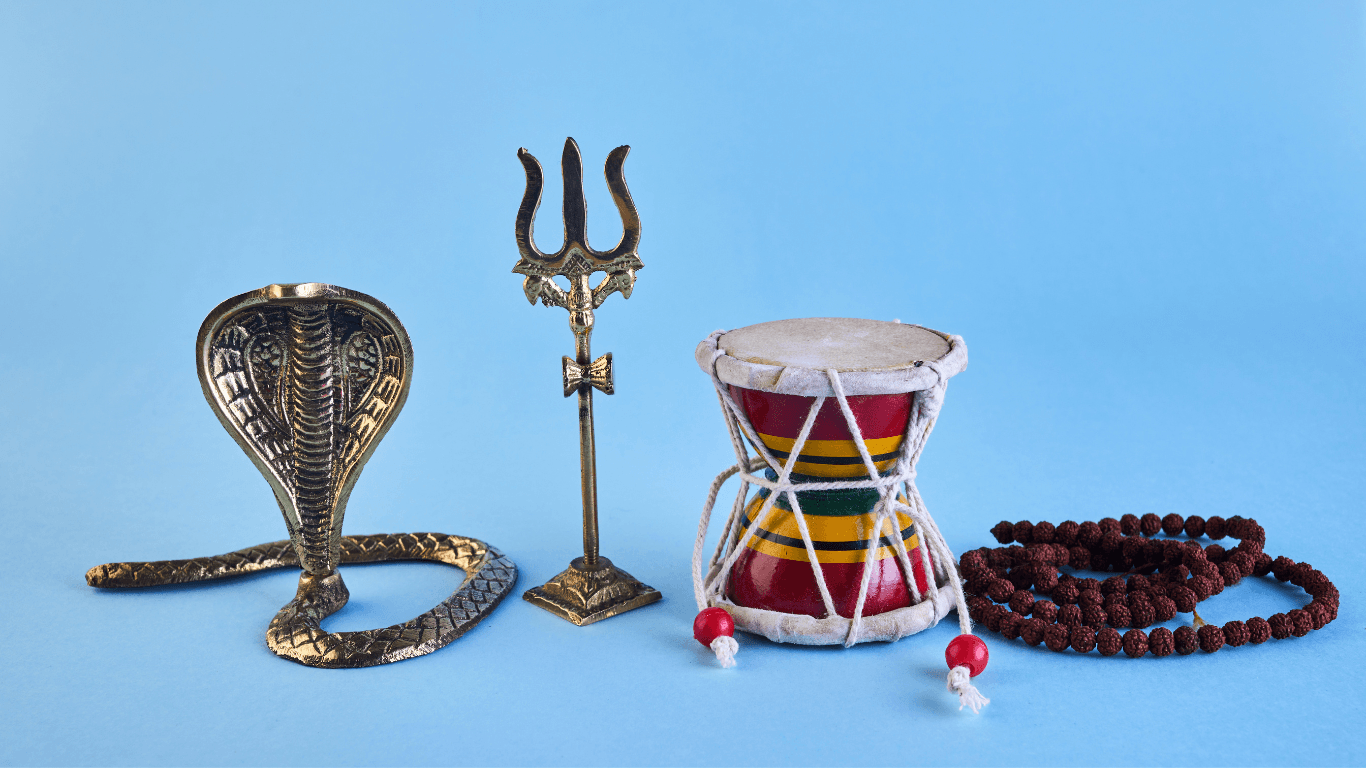
The Maha Shivaratri is not a festival that bursts outward, but inward.
When Maha Shivaratri arrives, the country becomes silent in a very special way. Temples stay open until dawn, oil lamps burn for hours and millions of people consciously decide not to sleep. Not because there is a party, but because they believe that on that night the conscience is more awake than ever.
The Meaning of Maha Shivaratri
Maha Shivaratri literally means the great night of Shiva.
But to understand it only as the celebration of a deity would be to stay on the surface, because this night has multiple readings within Hinduism, and each tradition lives it in a different way.
For many devotees it is the night Shiva joined with Parvati. It is not simply a mythological wedding: symbolizes the union between consciousness and energy., between the immobile and the dynamic, between the absolute and the manifested. Shiva represents pure consciousness; Parvati, life in movement. Their union expresses that existence only makes sense when both aspects are in balance.
Other currents, especially the Shaivites, consider that on this night, Shiva performed the Tandava, the cosmic dance. It is not a physical dance, but the eternal movement of the universe: creation, preservation and dissolution occurring continuously. That is why Shiva is not seen only as a destroyer, but as the principle that transforms to allow life to be reborn.
And in the yogic tradition the interpretation is even more interior. It is believed that during this night there is a natural energetic alignment that favors the vital energy to ascend in the human body. That is why devotees remain seated, awake and silent: they do not want to miss this opportunity.
It is not a question of asking, nor of celebrating something external.
It's about being available.
Many Hindus say that if you spend this night with mindfulness, even once in a lifetime, something changes inside of you. Not necessarily visibly... but irreversibly.
Shiva: the god who is not a god
Shiva is unlike any other deity in the Hindu pantheon.
He is not a king, nor a protector, nor a creator.
It is the yogi. The ascetic. The one who remains motionless in the mountains while the whole world happens.
It represents dissolution: the moment when everything false falls.
He does not destroy for punishment, but for deliverance.
That's why your festival is not exuberant.
Maha Shivaratri does not invite you to ask for prosperity and success... invites you to let go.
The Fast and the Vigil
During this day many people fast.
Some only drink water, others fruit or milk. The intention is not sacrifice, but lightness: the less heavy the body is, the easier it is to remain conscious.
When night falls, the vigil begins.
Entire families, monks, students, elderly people... stay awake until dawn.
Absolute presence.
We sing, meditate or simply observe the flame of a lamp. The idea is not to fall into unconsciousness. In the Indian tradition, sleeping symbolizes living in automatic; staying awake symbolizes living with attention.
Night Bidding step by step
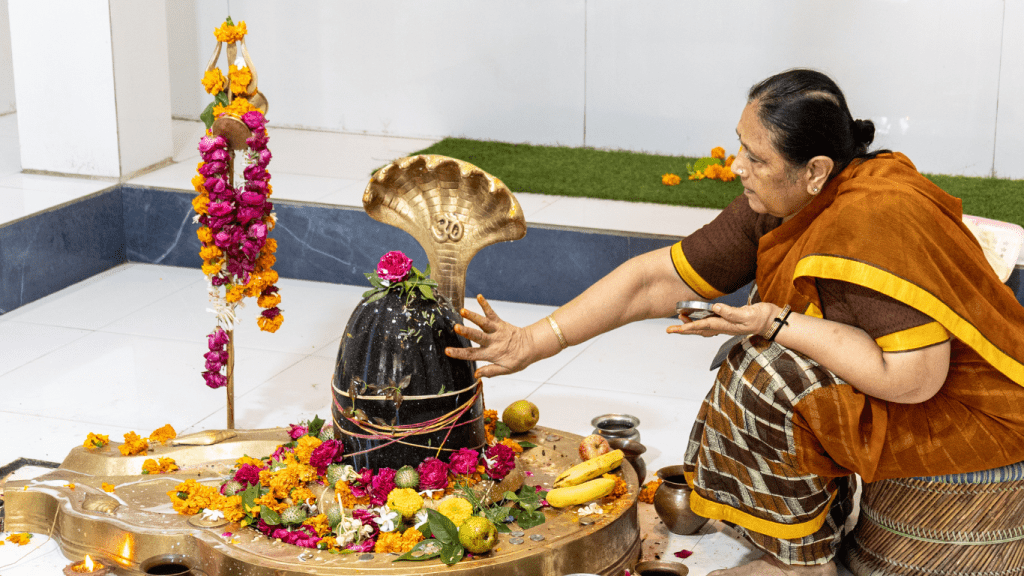
Shiva worship is performed around the lingam, a symbolic form that represents the primordial energy.
The night is divided into four periods and in each one the same ritual is repeated:
First the lingam is bathed with water, then with milk, then with yogurt or honey. And finally with water again.
Each ablution symbolizes purifying different levels of being: body, mind, emotions and energy.
As it happens, the devotees repeat mantras without haste.
They do not seek to end... they seek to remain.
Mantras and Meditation
The most repeated sound during Maha Shivaratri is: Om Namah Shivaya
It is not exactly a prayer.
It is more of a reminder: I bow to what I am in essence.
As the dawn progresses, the temples become quieter.
People stop talking. The energy changes.
Whoever has lived this night in India recognizes this moment: nothing happens and yet everything seems intensely alive.
The Offerings: the symbolism of the lingam
The leaves of bilva, The most common offerings are sacred ash and water from the Ganges.
Nothing is luxurious or complex. Shiva, according to tradition, accepts the simplest because it represents the unadorned essence.
The message is clear: spirituality does not depend on what you possess, but on what you drop.
Maha Shivaratri food
After sunrise comes the first meal. It is simple, light and comforting: fruits, potatoes, peanuts, sweets prepared with buckwheat or tapioca flour.
After a night of wakefulness, every bite feels different. It's not just hunger: it's a return to the body.
The best places to experience Maha Shivaratri in India
Although it is celebrated throughout the country, each city has a particular energy:
Varanasi: the eternal night by the Ganges
If there is a place where this night reaches its maximum intensity is Varanasi. Here Shiva is not only a deity: he is the god who guards the sacred city.
In the afternoon, long lines begin to form in front of the temple of Kashi Vishwanath. Thousands of pilgrims wait for hours to offer water from the Ganges to the lingam while repeating Om Namah Shivaya. The devotion is physical: tightly packed bodies, bells, incense smoke, flowers crushed by the crowd.
But the real shock begins in the early hours of the morning.
Sadhus walk the ghats in procession, chanting and playing the damarus. Some have not slept for days. Others stand motionless, gazing at the river.
A very characteristic element also appears in Varanasi: the bhang.
It is a ritual drink prepared with cannabis and spiced milk, traditionally associated with Shiva. It is not recreational in its origin, but symbolic: it represents the abandonment of mental limits and the expanded state of consciousness. During Maha Shivaratri it is legally sold in authorized stalls and many devotees consume it as part of the ritual.
The city does not sleep.
Neither does the Ganges.
Here the night is not silent... it is hypnotic.
Rishikesh: the inland version
In Rishikesh the energy changes completely. Less crowds, less pushing and shoving, more breathing.
Ashrams and yoga centers organize nightly meditations, mantra chanting and long sessions of silence. Many people spend hours just sitting and gazing at a candle flame or the dark river.
It is probably one of the best places to understand the yogic meaning of Maha Shivaratri. It does not impress by intensity, but by clarity.
Ujjain: the pure ritual
Ujjain is home to the Mahakaleshwar temple, one of the twelve holiest jyotirlinga in India.
Here Maha Shivaratri is strictly ritual.
Priests perform ceremonies every few hours throughout the night. The most special moment is the Bhasma Aarti, where the lingam is covered with sacred ash at dawn, recalling the ephemeral nature of life.
The feeling is different from Varanasi: less chaotic, more structured.
Kashmir and the north: celebrating at home
In the northern regions, especially in Kashmiri Pandit families, Shivaratri is lived within the home.
For days, traditional dishes are prepared, altars are cleaned and family pujas are performed that can last for hours. There are no crowds or large temples: there is intimacy.
It is a domestic Maha Shivaratri, passed down generation after generation.
Small temples: where everything makes sense
Interestingly, one of the most profound experiences often occurs away from famous places.
A small neighborhood temple, a few lamps, five people singing softly...
and suddenly the night becomes immense.
Because Maha Shivaratri does not depend on the magnitude of the temple, but on the internal state.
And sometimes, the less that happens on the outside, the more that happens on the inside.
The smaller the temple, the more intimate the experience tends to be.
Maha Shivaratri does not promise happiness or solutions. It proposes something more uncomfortable: to look at you without distractions.
That's why many travelers don't understand it... and others can never forget it.
It is not a night to observe India.
It is a night to observe you inside India.
If you have the opportunity to experience it once in a lifetime in India, don't miss it.
I hope you have discovered something new about the festival. Maha Shivaratri and that someday you can live it in first person :)
Om Namah Shivaya

Leave a Reply